TAXIING AND AIRPORT MARKINGS
October 2, 2018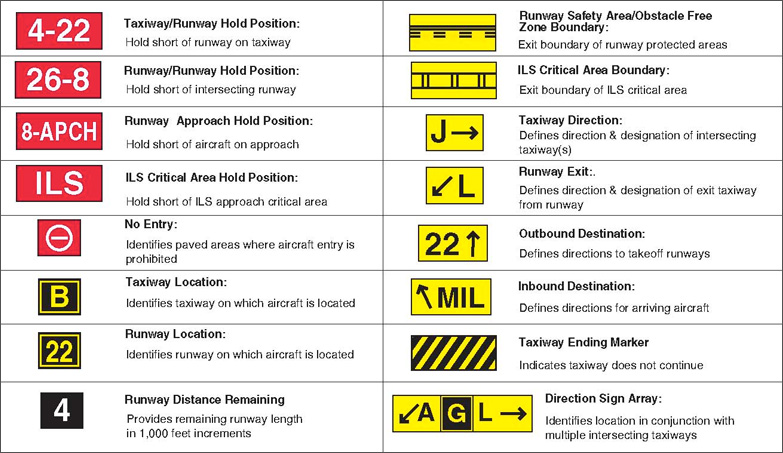
Content: Setting of controls for wind, use of rudders for directional control, kinds of airport signs and lighting, clearance instructions, runway incursion avoidance
Equipment:
Airworthy aircraft. PTS. Visual aids (Pictures from AIM 2-3-3).
Schedule:
Ground lesson: 20 minutes
In-aircraft ground lesson 10 minutes
Student practice: every time they’re in the plane from now on
Instructor:
Preflight: (see lesson plan) motivate, explain, list common errors, discuss.
On ground during taxi: Demonstrate proper taxiing technique and explain signs as they pass
Student:
Preflight: Attend to explanation, answer questions
On ground during taxi: Practice proper control position for wind, and rudder technique, answer questions regarding airport signs, clearances, and runway incursion avoidance.
Completion Standards:
Taxiing: Positions controls for wind, maintains control of aircraft with accuracy and safety, obtains and follows ATC ground clearances as appropriate
Airport markings: Can identify the various airport signs and runway/taxiway markings, understands meaning of rotating beacons at night and in daylight hours, shows understanding of lighting systems through use and explanation
GROUND LESSON:
TAXIING AND AIRPORT MARKINGS
Review: Ground operations
Objective: To learn proper taxiing technique, and how to interpret airport runway markings and lighting, and ground clearances. Runway incursion avoidance
Materials: Jeppesen pictures
An airplane isn’t meant to drive around, so it doesn’t do it very well, so learning to taxi properly is really very important.
The cool thing, is that once you’re on the ground, you’re safe, right? Oh, no! What if you pull out on to a runway when you aren’t supposed to, and a 747 bounces on top of you. That would be really bad. Fortunately, this is very easy to avoid, providing that you follow ATC clearances and you know what the runway markings mean.
DEVELOPMENT: Overview and explanation of taxiing: (2 minutes)
1. Get a clearance to taxi, and read it back
2. Do a brake check before getting rolling
3. Position controls for wind: dive away from, turn into wind
4. Use rudders for steering: small control movements
5. THROTTLE controls speed, not brakes. Use brakes very sparingly
6. Follow the appropriate markings and signs, and go according to clearance
Common errors: taxiing (2 minutes)
Trying to steer with the yoke. Pretty funny
Yoke not positioned correctly for wind
Not on the centerline
Poor speed control: brakes instead of throttle
Hand not on throttle
Disorientation
DEVELOPMENT: Overview and explanation of airport signs: (12 minutes)
Using pictures, explain:
Wind sock, tetrahedron, wind-T
Segmented circle
Six kinds of runway signs MIDDLR
Hold-short line
ILS hold-short line
Chevrons vs. displaced thresholds
Fixed-distance (aiming point) markings and touchdown zone indicators
Threshold markings and runway heading
Threshold (green/red) lights
Beacons: types and meaning, day and night
Blue taxiway edge lights
White runway edge lights
REIL
ALS
VASI, PLASI, PAPI, Tri-color VASI
Pilot-controlled lighting